Concrete Jungle Vibes: Exploring Brazzaville’s Urban Soul
You know what? Brazzaville isn’t just a capital city—it’s a living, breathing rhythm of contrasts. Between colonial echoes and modern African energy, its streets pulse with stories. I never expected such raw authenticity in an urban space so underrated. From market alleys to riverfront views, this is more than a destination—it’s a feeling. Let me take you through the real heartbeat of the Republic of the Congo. Here, life isn’t curated for cameras or polished for tourists. It unfolds in bursts of color, sound, and movement—on cracked sidewalks, under sun-bleached awnings, and along the mighty Congo River. This is a city shaped by resilience, improvisation, and community, where every corner holds a quiet testament to how people thrive amid complexity.
First Impressions: Stepping into Brazzaville’s Urban Pulse
Arriving in Brazzaville is like stepping into a film where the soundtrack begins before the visuals settle. The air is thick with humidity and the scent of fried plantains, diesel fumes, and ripe mangoes. Motorbikes weave through traffic with practiced ease, their riders balancing bundles of goods or entire families on the back. Alongside them, the iconic *taxi-bus*—brightly painted minibuses that serve as the city’s unofficial transit system—dart from stop to stop, honking to announce their presence. There’s no central arrivals hub, no sleek airport express. Instead, the city reveals itself gradually, through layers of noise, movement, and color.
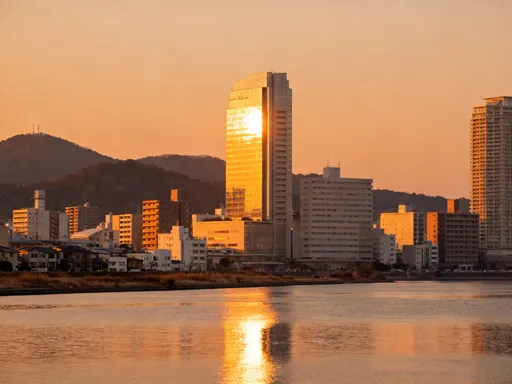
The downtown core, centered around Place de l’Indépendance, sets the tone for what’s to come. Wide boulevards laid out during the French colonial era intersect with narrow side streets where commerce spills onto the pavement. Government buildings with faded neoclassical facades stand next to newer concrete structures, their facades adorned with satellite dishes and air conditioning units. The contrast is not jarring—it’s familiar, even comforting. This is not a city trying to hide its imperfections. It wears them like badges of endurance. Graffiti marks some walls, while others are plastered with political posters or advertisements for mobile phone credit. Electricity poles sag under the weight of tangled wires, a visible reminder of the city’s constant negotiation with infrastructure.
What defines Brazzaville’s urban character is not grand monuments or manicured plazas, but the rhythm of daily life. People move with purpose—vendors setting up their stalls, office workers in crisp shirts navigating potholed sidewalks, children in school uniforms balancing notebooks on their heads. The informal economy is everywhere: women selling bottled water from plastic crates, men offering shoe shines from wooden boxes, teenagers hawking phone chargers and SIM cards. These small acts of commerce are not disruptions—they are the city’s lifeblood. In this way, Brazzaville feels honest. It doesn’t pretend to be something it’s not. It is a working city, shaped by the needs and ingenuity of its residents.
The Heartbeat of the City: Marché Total and Informal Commerce
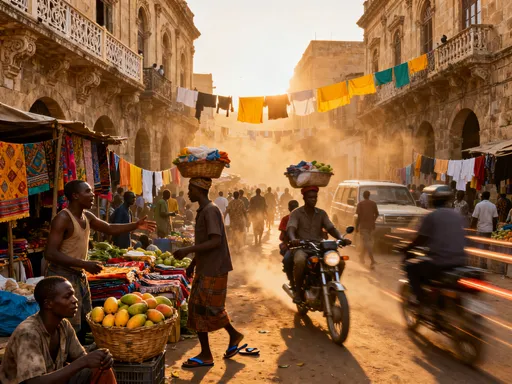
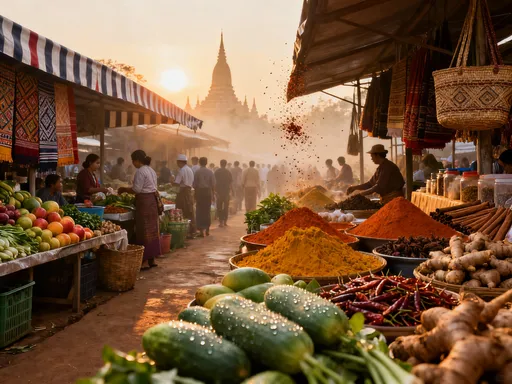
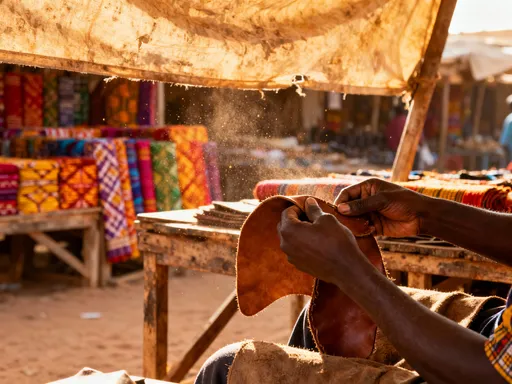
If Brazzaville has a soul, it beats loudest at Marché Total. One of the largest open-air markets in Central Africa, this sprawling network of stalls and alleyways is more than a place to shop—it’s a social ecosystem. From dawn until dusk, thousands pass through its covered corridors and sun-baked lanes, searching for everything from fresh cassava and smoked fish to second-hand clothing and knockoff electronics. The air hums with bartering, laughter, and the occasional burst of Lingala music from a vendor’s radio. Colors explode in every direction: stacks of wax-print fabrics in bold patterns, pyramids of red peppers, mounds of dried mushrooms tied in bundles.
Marché Total is not organized by department or category. Instead, goods cluster organically—fabric sellers near tailors, phone credit vendors next to charging stations, food stalls surrounding shaded seating areas where customers sip sugary tea. This chaos has its own logic. Vendors know their neighbors, form alliances, and share resources. Some rent permanent stalls, while others arrive daily with baskets balanced on their heads, claiming the same patch of ground through unspoken agreement. This informal structure is not a sign of disorder—it’s a testament to adaptability. In a city where formal retail is limited and often unaffordable, markets like this fill essential gaps.
The economic significance of Marché Total cannot be overstated. It provides livelihoods for tens of thousands, many of them women who run small but vital businesses. A single fabric seller might reinvest her daily profits into her children’s school fees, while a food vendor uses her earnings to rent a room in a crowded household. These micro-transactions sustain families and neighborhoods. Moreover, the market serves as a cultural hub. News spreads here faster than on social media. Local musicians promote their latest songs. Community leaders gather to discuss neighborhood issues. In this way, the market is not just about commerce—it’s about connection.
Yet, challenges persist. The lack of sanitation infrastructure means waste accumulates in corners, attracting flies and rodents. Rain turns unpaved sections into muddy streams. During the dry season, dust coats everything. There are no public restrooms, and clean water is scarce. Despite these conditions, the market thrives. Why? Because it meets real needs—affordability, accessibility, and a sense of belonging. Efforts to formalize or relocate the market have faced resistance, not because vendors oppose progress, but because they fear losing the very things that make it work: proximity, flexibility, and community trust.
Architecture as Memory: Colonial Remnants and Post-Independence Growth
Drive through neighborhoods like Bacongo, Talangaï, or Poto-Poto, and you’ll see Brazzaville’s history written in brick, concrete, and corrugated metal. The city’s architectural landscape is a patchwork of eras, each layer telling a different chapter of its story. In the early 20th century, French colonial planners laid out wide streets and built administrative buildings with white columns, shuttered windows, and red-tiled roofs. These structures were designed to project authority and order, often segregating European residents from Congolese communities.
Today, many of these colonial buildings still stand, though their condition varies. Some have been repurposed—former villas now serve as government offices, schools, or private homes. Others are crumbling, their facades cracked, roofs sagging, windows boarded up. Yet even in decay, they hold a certain dignity. Their presence is a reminder of a complex past, not erased but absorbed into the city’s fabric. In contrast, the post-independence period saw rapid urban expansion. As people migrated from rural areas, new neighborhoods sprang up with minimal planning. Homes were built from whatever materials were available—cinder blocks, wood, and corrugated iron. Electricity and running water arrived slowly, if at all.
In recent decades, a new wave of construction has reshaped parts of the city. Apartment blocks with glass balconies and satellite dishes rise alongside older structures. Some are funded by foreign investment, particularly from China and other Asian partners, reflecting shifting geopolitical ties. These buildings offer modern amenities but are often unaffordable for most residents. The result is a city of contrasts: gleaming facades next to open sewers, luxury cars parked beside street vendors.
The urban layout still reflects its colonial roots—grid-like streets in the center, with radiating avenues. But organic growth has transformed it. Narrow footpaths cut through undeveloped lots, becoming unofficial shortcuts. Informal settlements expand along riverbanks and railway lines. This duality—planned versus unplanned—defines Brazzaville’s spatial identity. It is a city shaped by both design and necessity, where the past is not demolished but adapted. The resilience of its people is visible in how they inhabit these spaces: painting bright murals on cracked walls, turning empty lots into soccer fields, and transforming rooftops into social gathering spots.
Green Spaces in the Concrete: Leisure and Urban Design
In a city defined by density and movement, green spaces are rare but deeply cherished. Parc des Braves, located near the city center, is one of the few official parks where families gather on weekends. Shaded by tall palm trees and jacarandas, it offers benches, a small playground, and open lawns where children run and couples sit quietly. On Sundays, the park buzzes with activity—vendors sell grilled corn and cold drinks, teenagers practice dance routines, and older residents play checkers under the trees. It is one of the few places in Brazzaville where people can linger without a commercial purpose.
Other green spaces are more modest. The riverside promenade near the Presidential Palace, though not always well-maintained, draws evening strollers who come for the breeze off the Congo River. Roundabouts with flower beds and benches serve as impromptu meeting points. Even small patches of grass between buildings become informal play areas. These spaces, however limited, play a crucial role in quality of life. They offer relief from the noise and heat, a chance to breathe, to connect, to simply be.
Yet, well-maintained public parks are scarce. Urban planning has historically prioritized roads and government buildings over recreational spaces. Many existing parks suffer from neglect—broken benches, litter, and inconsistent maintenance. In some areas, green spaces have been encroached upon by informal vendors or converted into parking lots. This lack of investment reflects a broader challenge: public space is often seen as secondary to economic or administrative needs.
Despite these limitations, residents find ways to reclaim space. In neighborhoods without parks, people gather on stoops, in courtyards, or along quieter streets. Community groups occasionally organize clean-up events or plant trees. Youth collectives have painted murals on blank walls, turning eyesores into points of pride. These grassroots efforts show that the desire for beauty and leisure is strong, even when infrastructure lags. The need for green, accessible public spaces is not a luxury—it’s a fundamental part of urban well-being. As Brazzaville grows, investing in parks and recreational areas could transform not just the city’s appearance, but its social fabric.
Moving Through the City: Transport Chaos and Commuter Culture
Navigating Brazzaville means mastering a transport system that exists largely outside formal regulation. The *taxi-bus*—a minivan or minibus with no fixed route or schedule—is the backbone of daily mobility. These vehicles, often painted in bright colors with names like “Dieu est Bon” or “Merci Seigneur,” pick up passengers along major corridors, stopping wherever someone waves. Fares are low, routes are flexible, and drivers know every shortcut through the city’s labyrinthine streets.
While this system may seem chaotic to outsiders, it operates on its own internal logic. Drivers and conductors develop routines, recognize regular passengers, and communicate through gestures and calls. There is an unspoken code: passengers board in order, fares are paid promptly, and disputes are settled quickly. This informal network moves far more people than any official bus system could, precisely because it is responsive to real needs. It connects residential areas to markets, schools, and workplaces, filling the gaps left by inadequate public transit.
Yet, the strain is visible. Traffic congestion is a daily reality, especially in districts like Makelekele and Owando, where narrow roads were not designed for the current volume of vehicles. During rush hours, progress slows to a crawl. Motorbikes, cars, and *taxi-bus* compete for space, creating a symphony of honking and shouting. Accidents are common, and emergency response is often delayed. The lack of traffic enforcement and urban planning exacerbates the problem.
Meanwhile, efforts to modernize transport have been slow. Proposals for a formal bus rapid transit system have been discussed for years but remain unrealized. Some residents welcome the idea, hoping for safer, more reliable service. Others worry that formalization could displace the very drivers who keep the city moving. The challenge lies in improving efficiency without dismantling the informal networks that millions depend on. A sustainable solution would integrate the best of both worlds—respecting existing systems while investing in infrastructure, safety, and accessibility.
The River as Urban Edge: Congo River and the View to Kinshasa
The Congo River is not just a geographic feature—it is a central character in Brazzaville’s story. At nearly 470 kilometers wide at this point, it forms a natural border with Kinshasa, the capital of the Democratic Republic of the Congo. On clear days, the skyline of Kinshasa is visible across the water, a constant, silent dialogue between two cities shaped by shared history but different paths. Ferries, barges, and wooden *pirogues* traverse the river daily, carrying people, goods, and animals. The ferry terminal at Pointe-Noire Quay is a hub of activity—passengers queue for tickets, vendors sell snacks, and luggage is loaded by hand.
For Brazzaville’s residents, the river is both a resource and a refuge. Fishermen cast nets at dawn, their silhouettes stark against the morning light. Women wash clothes on the banks, their rhythmic beating echoing along the shore. Children swim in the shallows, supervised by elders sitting under umbrellas. Boat builders repair *pirogues* using traditional techniques passed down through generations, shaping wood with hand tools and caulking seams with natural resin. These daily rituals connect the city to its environment in a tangible way.
The waterfront could be a cultural and recreational spine for the city. Imagine a clean, accessible promenade with cafes, art installations, and public seating—something that celebrates the river’s beauty and significance. Yet, pollution and neglect threaten this potential. Plastic waste floats in the current, and untreated runoff enters the water from informal settlements. Erosion eats away at the banks, endangering nearby homes. Without coordinated environmental management, the river’s health—and the city’s connection to it—will continue to degrade.
Still, there are signs of hope. Local NGOs and community groups have launched clean-up campaigns. Artists have created sculptures from river debris, turning trash into statements. Some city officials recognize the river’s symbolic and economic value and have proposed development plans, though implementation remains slow. The river is more than a border—it is a lifeline. Protecting it is not just an environmental imperative but a cultural one.
The Future of Urban Space: Challenges and Quiet Transformations
Brazzaville faces significant urban challenges. Overcrowding, inadequate waste management, and unequal access to clean water and sanitation affect daily life for many. Power outages are frequent, and internet connectivity can be unreliable. Informal settlements lack basic services, yet they house a large portion of the population. These issues are not new, but they are intensifying as the city grows. Without strategic investment and inclusive planning, the gap between infrastructure and need will only widen.
Yet, beneath the surface, quiet transformations are underway. Youth-led collectives are painting vibrant murals in public spaces, turning gray walls into canvases of hope and identity. Small NGOs advocate for better urban policies, pushing for pedestrian-friendly streets, improved sanitation, and community participation in planning. Local entrepreneurs are launching recycling initiatives, turning plastic waste into building materials. These efforts may seem small, but they reflect a growing awareness: the city’s future depends not just on government action, but on civic engagement.
The question is not whether Brazzaville will change—but how. Can it grow without losing its soul? Can modernization coexist with authenticity? The answer lies in listening to residents, especially those in marginalized neighborhoods. Urban space is not just about buildings and roads—it’s about belonging. When people feel ownership over their environment, they care for it, improve it, and pass it on with pride.
Investing in infrastructure must go hand in hand with preserving culture. New developments should incorporate green spaces, pedestrian access, and affordable housing. Transport reforms should build on, not dismantle, existing systems. Environmental protection must be prioritized, especially along the riverfront. And above all, planning must be inclusive—shaped by the voices of those who live, work, and dream in this city every day.
Why Brazzaville’s Urban Fabric Matters
Brazzaville does not dazzle like Paris or pulse like Lagos. It does not boast skyscrapers or global brands on every corner. But it offers something rarer: authenticity. Its streets tell a deeper story—one of adaptation, resilience, and human rhythm. To walk through Brazzaville is to witness urban life as it is lived, not as it is marketed. It is a city where community thrives in the cracks, where beauty emerges from improvisation, and where the past and present coexist in constant conversation.
Understanding Brazzaville’s urban fabric is not just about architecture or maps. It’s about seeing how life unfolds in the in-between spaces—on market stools, riverbanks, and sidewalk corners. It’s about recognizing that a city’s soul is not in its monuments, but in its people. For travelers seeking genuine connection, this city offers a rare glimpse into African urbanism on its own terms. It challenges assumptions, invites curiosity, and rewards patience.
So let’s stop overlooking it. Let’s see Brazzaville not as a footnote, but as a vital chapter in the story of African cities. Let’s appreciate its complexity, support its quiet transformations, and honor its rhythm. Because in the end, a city is not defined by its perfection—but by its pulse. And Brazzaville? It’s very much alive.