You Won’t Believe What Rotorua’s Buildings Can Tell You
Walking through Rotorua feels like stepping into a living story where every building whispers secrets of Māori tradition and volcanic earth. I never expected architecture here to be so alive—steaming, carved, rooted in culture. From ancient meeting houses to modern designs inspired by geothermal forces, the structures aren’t just built—they breathe. This is more than sightseeing; it’s a cultural heartbeat you can see and feel. In a world where cities often look the same, Rotorua stands apart, where design emerges not from trends but from deep connection—to ancestors, to nature, and to community. To walk its paths is to witness how buildings can carry memory, meaning, and mission all at once.
The Soul of the Land: How Rotorua’s Culture Shapes Its Architecture
In Rotorua, architecture does not begin with blueprints or zoning laws. It begins with breath, with land, with belonging. The Māori worldview sees no separation between people and place—this concept, known as *whenua*, shapes every aspect of life, including how spaces are designed and used. Buildings here are not mere shelters; they are extensions of identity, expressions of lineage, and vessels of spiritual balance. The land is not passive ground to be developed, but an ancestor to be respected, listened to, and lived in harmony with. This philosophy fundamentally alters the purpose of architecture: it is not about dominance over nature, but dialogue with it.
This deep cultural connection manifests in the way buildings are oriented, constructed, and used. Spaces are designed to reflect communal values rather than individualism. For instance, the placement of a *wharenui* (meeting house) on a *marae* is never arbitrary—it faces a specific direction based on ancestral pathways and spiritual considerations. The surrounding open space, known as the *marae ātea*, serves as a threshold between the sacred and the everyday, where visitors are welcomed and protocols observed. Every element, from the foundation to the roof, is imbued with meaning, often reflecting cosmological beliefs or tribal histories.
Another central concept shaping architecture is *tapu*—a term often translated as 'sacred' or 'restricted.' This principle governs access, behavior, and construction. Certain areas within a building may be *tapu*, reserved only for specific people or rituals. Materials used in construction, such as native timbers like totara, are chosen not just for durability but for their spiritual significance. The process of building itself is often accompanied by ceremonies to acknowledge the land and seek permission from ancestors. This ensures that creation is not an act of imposition, but one of reciprocity.
What makes Rotorua unique is how these cultural principles are not relics of the past but living guides for present-day design. Even modern civic buildings incorporate Māori values in their layout and function. Architects consult with local iwi (tribes) to ensure that new developments honor the cultural landscape. This collaborative approach results in structures that are not only functional but spiritually grounded. In this way, Rotorua’s architecture becomes a continuous conversation between past and present, tradition and innovation, people and place.
Wharenui: The Heartbeat of Māori Architectural Tradition
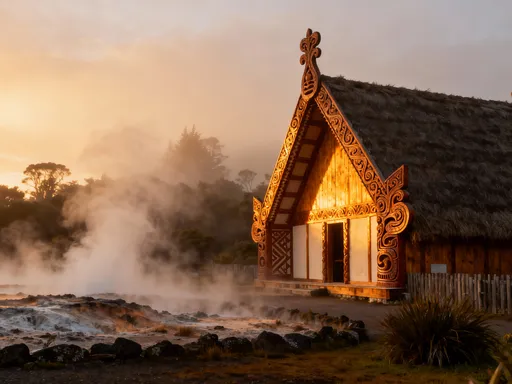
At the center of Māori architectural tradition stands the *wharenui*, the elaborately carved meeting house that serves as the heart of community life. More than a building, the *wharenui* is a living ancestor, a physical embodiment of tribal identity. Its construction is a sacred undertaking, often taking years and involving master carvers, weavers, and elders who ensure every detail carries meaning. The house is not named after a person but often *is* the person—representing a founding ancestor, with its structure mirroring the human form. The roof is the spine, the ridgepole the backbone, the carved figures the ribs, and the front bargeboards the outstretched arms welcoming visitors.
Entering a *wharenui* is not like walking into a museum or a hall. It is an act of entering a living presence. The interior is rich with carvings and woven panels, each telling stories of migration, ancestry, and tribal achievements. These are not decorative elements—they are records, passed down through generations in wood and fiber. The central pole, known as the *pou tokomanawa*, represents the heart of the tribe, anchoring the house and symbolizing strength and continuity. Above, the rafters may bear names of ancestors, linking the present to the past in a visible lineage.
The *wharenui* exists within a larger complex called the *marae*, which includes the open courtyard, cooking areas, and sleeping quarters. The *marae* is where major life events are celebrated—births, weddings, funerals—and where decisions are made collectively. It is a space of learning, hospitality, and spiritual connection. For visitors, being invited onto a *marae* is a privilege, not a right. It requires adherence to *tikanga* (customary practices), such as removing shoes before entering the *wharenui*, speaking only when invited, and showing respect to elders.
One of the most powerful aspects of the *wharenui* is its role in language and cultural transmission. Inside its walls, Māori is spoken, songs are sung, and stories are told in ways that cannot be replicated elsewhere. The building itself becomes a teacher, its carvings prompting questions, its space fostering dialogue. For younger generations, spending time on the *marae* is how they learn who they are and where they come from. In this way, the *wharenui* is not just preserved—it is actively used, renewed, and kept alive through daily practice and ceremony.
Carving Stories in Wood and Stone: Craftsmanship as Cultural Language
Māori wood carving, or *whakairo*, is far more than an art form—it is a language carved in timber, a way of preserving history, genealogy, and spiritual belief. Every curve, every spiral, every chisel mark carries intention and meaning. In Rotorua, this craftsmanship is not confined to museums; it is embedded in the very structures people live in, gather in, and honor their ancestors within. The carvings on a *wharenui* are not random decorations but a visual narrative, telling of tribal origins, heroic deeds, and the relationship between humans and the divine.
Among the most recognizable motifs is the *koru*, a spiral shape based on the unfurling fern frond. Symbolizing new life, growth, and harmony, the *koru* appears in carvings, tattoos, and woven designs. It reflects the Māori understanding of life as a continuous cycle—birth, death, and renewal. Another common pattern is the *tāniko*, a geometric weaving design used in textiles but often echoed in architectural details. These patterns are not merely aesthetic; they are mnemonic devices, helping to pass down knowledge across generations without written records.
The creation of these carvings is a sacred responsibility entrusted to *tohunga whakairo*, master carvers who undergo years of training under elder mentors. This apprenticeship is not just technical—it is spiritual and cultural. Carvers must understand tribal history, speak the language, and follow strict protocols before they can begin work. The tools themselves—traditionally made of stone or bone—are treated with reverence. Even today, many carvers begin their work with a karakia (prayer) to acknowledge the tree that gave its life and the ancestors who guide their hands.
Visitors to Rotorua can witness this living tradition at cultural centers such as Te Puia or the Whakarewarewa Living Village, where carvers work in open studios. These spaces offer a rare opportunity to observe the craft up close, ask questions, and gain insight into its deeper meanings. However, it is important to approach with humility and respect. Photography may be restricted, and some carvings depict sacred stories not meant for public sharing. The goal is not to consume culture as entertainment, but to appreciate it as a living, evolving practice that continues to shape identity and community.
Modern Meets Ancient: Contemporary Architecture Inspired by Tradition
While Rotorua honors its past, it is not frozen in time. The city’s modern architecture demonstrates a thoughtful fusion of tradition and innovation, where ancestral principles inform contemporary design. Civic buildings, visitor centers, and cultural institutes are increasingly shaped by *te ao Māori* (the Māori world) while meeting the needs of a modern society. This is not about replicating old forms, but about translating cultural values into new expressions—creating spaces that are both functional and spiritually resonant.
One of the guiding principles in this evolution is *kaitiakitanga*, the concept of guardianship over the natural world. Modern buildings in Rotorua often use locally sourced materials such as timber, stone, and rammed earth, reducing environmental impact while maintaining a connection to the land. Roofs may follow the curve of nearby hills, and windows are positioned to frame sacred mountains or geothermal vents. Orientation is carefully considered—not just for sunlight, but for cultural alignment, such as facing a tribal marae or ancestral landmark.
The Rotorua Museum, housed in a beautifully restored Edwardian-era bathhouse, exemplifies this blend. While the original structure reflects colonial architecture, recent renovations have incorporated Māori design elements, including carved pou (posts) and woven panels that acknowledge the mana whenua (local tribes). Interpretive displays are presented in both English and te reo Māori, reinforcing the importance of language in cultural preservation. The building itself becomes a bridge—between histories, between peoples, between past and future.
Newer developments, such as the Te Ao Mārama multipurpose center, take this integration further. Designed in collaboration with local iwi, the building features a sweeping roofline reminiscent of a *waka* (canoe), symbolizing journey and unity. Interior spaces are flexible, allowing for meetings, performances, and educational programs, all within an environment that reflects Māori values of community and connection. Even the lighting and acoustics are tailored to support traditional practices like karakia and waiata (singing). This is architecture not as a backdrop, but as an active participant in cultural life.
Geothermal Energy as an Architectural Muse
Rotorua sits on a volcanic plateau, where the earth breathes steam and hot springs bubble to the surface. This dynamic environment is not just a tourist attraction—it is a fundamental influence on how buildings are designed and used. For centuries, Māori have lived in harmony with these forces, using natural heat for cooking, bathing, and heating homes. Today, architects continue this legacy, designing structures that work *with* geothermal energy rather than against it.
Traditional Māori cooking, known as *hāngī*, involves placing food in baskets into pits heated by volcanic stones. This practice is still widely used and often takes place in designated areas near marae or community centers. The design of these spaces includes stone-lined pits, sheltered enclosures, and seating arranged for communal sharing—blending function with cultural ritual. The smell of earth-cooked meat and vegetables rising with the morning mist is a sensory experience that connects people to the land in the most direct way.
Modern buildings in Rotorua also harness geothermal energy in innovative ways. Some homes and public facilities use underground pipes to channel hot water for heating and hot water supply, reducing reliance on fossil fuels. Bathhouses and wellness centers are built directly over thermal springs, with pools designed to blend into the natural landscape. The architecture often features stone walls, wooden decks, and open-air layouts that enhance the experience of steam and warmth while maintaining a sense of tranquility.
Crucially, development in geothermally active areas requires careful planning. Architects must avoid building on unstable ground or disrupting natural vents. This means that design is not imposed but negotiated—with the land itself. Structures are often elevated, or built in clusters that follow the contours of steam fields. In this way, Rotorua’s architecture becomes a form of listening, a response to the earth’s rhythms rather than an attempt to control them. The result is a built environment that feels alive, where steam curls around foundations and warmth radiates from the ground, reminding everyone that they are standing on living earth.
Where to Experience Authentic Māori Architecture (Without Overstepping)
For travelers seeking to understand Māori architecture, Rotorua offers several respectful and meaningful opportunities. The key is to approach with humility, follow protocols, and recognize that some spaces are not tourist attractions but living cultural centers. The best experiences come through guided visits, where knowledge is shared by those who belong to the culture.
Te Puia, located just outside Rotorua, is one of the most accessible places to witness traditional architecture in action. Home to the New Zealand Māori Arts and Crafts Institute, it features a fully carved *wharenui*, geothermal activity, and live demonstrations of carving and weaving. Visitors are welcomed with a *pōwhiri* (formal greeting) and guided through the site with explanations of cultural significance. This is not a staged performance but a living community where apprentices train and elders pass on knowledge.
Another important destination is the Whakarewarewa Living Māori Village, where descendants of the Tūhourangi and Ngāti Wāhiao tribes have lived for centuries. The village includes traditional *whare* (houses) built over natural steam vents, used for heating and cooking. Guided tours explain daily life, architectural adaptations, and the ongoing relationship with the geothermal environment. Visitors walk on designated paths, respecting private areas and sacred sites.
The Rotorua Lakes Council building and the University of Waikato’s Bay of Plenty campus also feature contemporary designs inspired by Māori principles. While not traditional, these spaces reflect ongoing cultural integration in public life. Murals, carvings, and spatial layouts honor local iwi and promote inclusivity.
It is essential to avoid trespassing on marae or private land, even if they appear open or are labeled as 'hidden gems' on social media. Sacred spaces are not photo opportunities. Always seek permission, follow host instructions, and practice basic respect—remove shoes, silence phones, listen more than speak. By doing so, visitors become guests, not intruders, and contribute to the preservation of culture rather than its commodification.
Why This Matters: Preserving Culture Through Built Spaces
The buildings of Rotorua are not relics behind glass. They are living, breathing expressions of a culture that has endured, adapted, and thrived. Each carved beam, each steam-warmed wall, each carefully oriented doorway carries the weight of history and the hope of continuity. In a world where globalization often erases difference, Rotorua’s architecture stands as a powerful assertion of identity—proof that tradition can evolve without being lost.
Preserving these structures is not just about saving old buildings. It is about safeguarding language, stories, and ways of being. When a *wharenui* is rebuilt, it is not a replica—it is a continuation. The same carvings, the same names, the same rituals ensure that the past remains present. Young people learn by doing—by helping to rebuild, by listening to elders, by sleeping under ancestral roofs. This is how culture survives—not in books, but in practice.
For travelers, the lesson is clear: to visit Rotorua is not just to see sights, but to witness resilience. It is to understand that architecture can be a form of resistance, a way of saying, 'We are still here.' Every curve inspired by the land, every carving passed down through generations, is a declaration of belonging. The steam that rises from the earth is matched by the spirit that rises from the people.
So walk gently. Listen closely. Let the buildings speak. And when you leave, carry not just photographs, but understanding. Rotorua’s architecture is not just something to admire—it is something to honor, protect, and remember. In its beams and carvings, in its steam and silence, lies a culture that breathes, lives, and endures.